
Heirloom
Project Overview
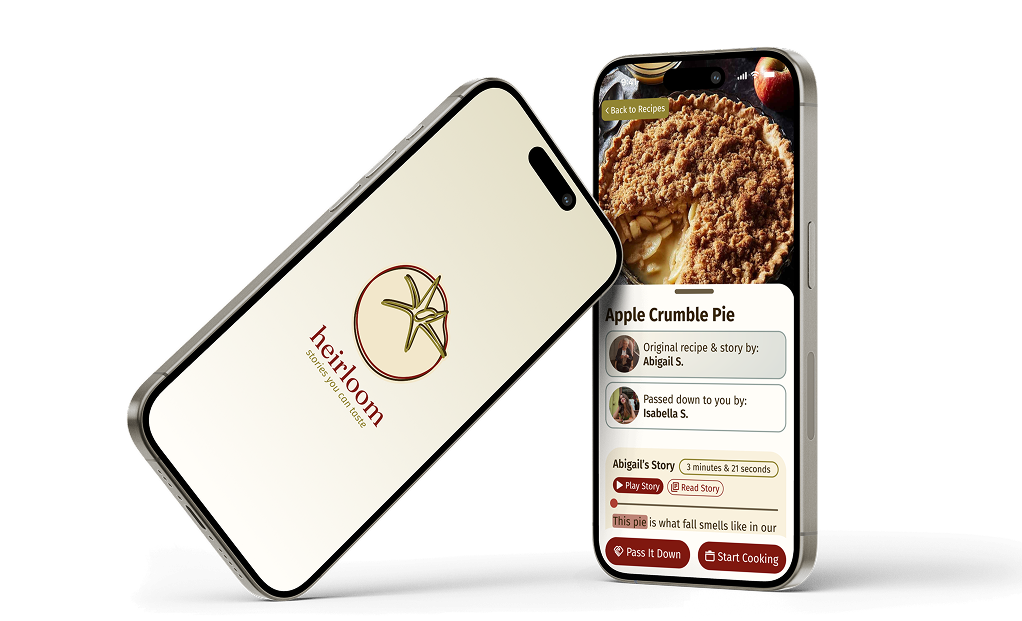
Heirloom was designed solo in 48 hours for the 2026 Rice Design-A-Thon, with the prompt: "Design a platform that helps bridge generational gaps." Rather than approach generational connection abstractly, I anchored the concept in something concrete, the family kitchen, and the knowledge that lives there and nowhere else. Heirloom is a digital space where family recipes are preserved the way they were originally taught, through voice, memory, and shared experience. It bridges generational gaps by capturing not just ingredients and instructions, but the stories, dialects, and lived wisdom behind each dish. Designed to be slow, human, and intergenerational, Heirloom preserves more than flavor. It carries memory, belonging, and culture from one kitchen to the next.
Timeline
Jan 30 – Feb 1, 2026
48 Hour Design-A-Thon
Tools
Figma
Role
UX/UI Designer
The Problem
Think about the last time a grandparent or elder cooked something for you. They probably didn't follow a recipe. They knew when the dough felt right, how long to simmer something "until it smells ready," which spice to add "a little extra of" without measuring. That knowledge is exactly what traditional recipe apps can't capture.
When elders pass, that knowledge often goes with them.
Existing recipe platforms are built for optimization: clean ingredient lists, precise measurements, step-by-step instructions. They're useful, but they're not human. They don't capture a grandmother's voice, the story of where a dish came from, or the feeling of standing beside someone in a kitchen and learning just by being there.
How might we preserve the full emotional and cultural experience of family cooking — not just the recipe itself?
Research
The Generational Divide
Generational communication gaps within families have reached concerning levels. Research indicates that 50% of adolescents and 40% of parents acknowledge a meaningful gap exists — yet the same research emphasizes that empathy-driven, shared activities can effectively bridge these divides. Cooking together is exactly that kind of activity.
Recipes as Cultural Memory
55% of Americans have a treasured family recipe passed down through generations, with over 52% of those recipes being more than 25 years old. Research on food-evoked nostalgia shows that revisiting familiar dishes promotes social connection and identity continuity across the lifespan. A recipe isn't just a method — it's a memory, an identity, a piece of someone.
Market Landscape
The global recipe app market was valued at approximately $724 million in 2024 and is projected to reach $2.27 billion by 2033. 81% of U.S. consumers prepare more than half of their meals at home, and 53% used a recipe app or website at least once a month in 2023. Most tellingly: social and sharing features influence approximately 45% of user interactions on recipe platforms. People don't just want instructions — they want community and shared experience alongside them.
Design Implications
These findings pointed toward a specific and underserved gap: a recipe platform that acts as an intergenerational bridge, transforming cooking into a storytelling practice that evokes nostalgia, reinforces identity and belonging, and creates meaningful human connection across generations — while being genuinely accessible to the elders at the heart of it.
Design Decisions
Every decision in Heirloom was made in direct response to something the research revealed. In a 48-hour sprint, there's no room for arbitrary choices, every hour spent on a feature is an hour not spent on another. Each decision below reflects that constraint.
Accessibility First
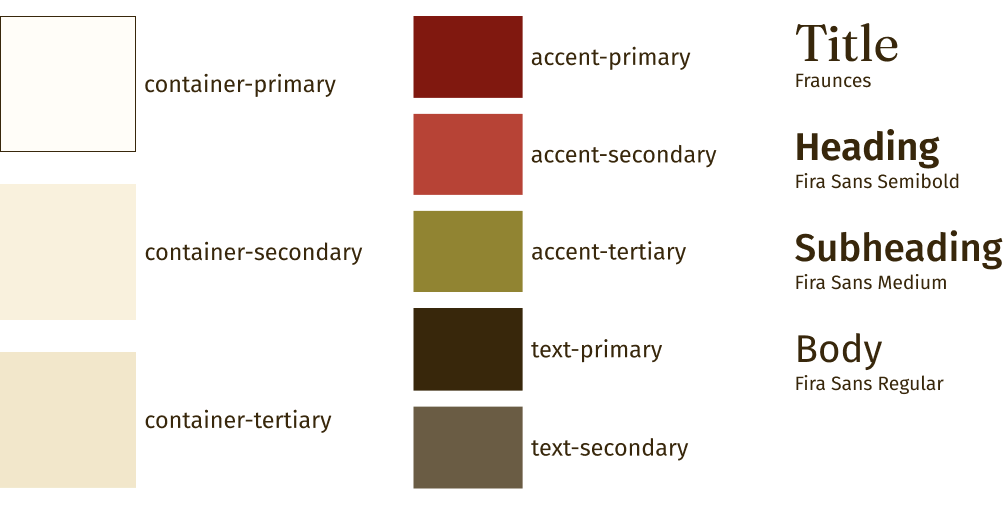
Because Heirloom is built for multiple generations, accessibility wasn't a feature to add at the end. It was a design constraint from the start. I implemented WCAG AA-compliant high-contrast colors, selected legible and scannable typefaces, and avoided overly dense layouts. Touch targets and spacing were designed for users with motor challenges. Clear hierarchy and generous spacing reduce cognitive load while keeping the interface visually engaging for younger users.
The goal was an app that an 80-year-old could pick up and navigate independently, because if elders can't use it comfortably, the whole concept falls apart.
Voice-First Features
The insight that many recipes can't be written down led directly to Heirloom's most distinctive feature: elder narration. Recipes are paired with recorded audio walkthroughs so younger users are guided through cooking as if standing beside someone in the kitchen. This preserves dialects, personality, and the kind of lived context that a typed recipe can never hold.
No Likes. No Followers
Likes and followers were excluded entirely. The reasoning: Heirloom's primary user, the elder sharing a recipe, shouldn't have to worry about engagement metrics or social performance. That anxiety would undermine the whole experience.
At the same time, the research showed that social features drive 45% of recipe app engagement. So rather than ignoring community entirely, I channeled it into something more intentional: "Passed to You" — a section that surfaces recipes shared directly by family and friends. This mirrors how recipes have always actually been passed down, through personal relationships rather than public broadcasts.
Story Before Instructions
Research showed that recipes are deeply tied to memory and identity, people seek family dishes because they evoke nostalgia and emotional comfort. This informed the decision to lead each recipe with a personal story, placing it before the instructions. The cooking is still there. But the meaning comes first.
Branding & Style Guide
The research showed that nostalgia and emotional comfort are central to how people relate to family food, so the visual language had to match that. Heirloom's brand had to feel timeless: warm enough for an elder to trust, refined enough for a younger user to love.
Final Design
Final Prototype
At the end of the 48 hour design-a-thon, this was the final prototype:
Critique & What I'd Do Differently
After the design-a-thon, I received formal feedback from the judges that pushed my thinking further than the project itself did.
The core critique: Heirloom is thematically differentiated, but not yet structurally differentiated. Remove the intergenerational framing and much of the interface, the Discover page, trending sections, public browsing, still functions like a familiar recipe app. The voice layer is compelling, but additive rather than transformative. The judges pushed toward a sharper vision: ancestry.com for food. Every recipe tied to a person and a lineage. A visual family tree where dishes branch, evolve, and carry notes across generations. The entire system built around three moments, recording a story, cooking alongside a voice, passing a recipe down, rather than layering those moments into a broader marketplace.
What I'd change in the next iteration:
Given the 48-hour constraint, scope was always going to be a limitation. But if I were to continue, the Discover and trending sections would go entirely, replaced by a visual map of a recipe's lineage across family branches. That one feature would do more to distinguish Heirloom than any amount of branding.
I'd also anchor the product to a sharper problem statement: the loss of oral tradition, the erosion of cultural lineage, and the absence of voice-based teaching in digital spaces are related but distinct problems, and which one you anchor to changes what the product needs to do structurally.
Key Takeaways
The constraint was the concept.
Every interesting design decision in Heirloom came from one constraint: make it genuinely usable by elders. That ruled out engagement mechanics, complex navigation, and information density. Designing within those limits helped to define the product.
Research shaped the product.
The secondary research wasn't gathered to justify decisions already made. It surfaced the problem more clearly, particularly the data around the emotional weight of family recipes. Those findings changed how I thought about what the app needed to do, not just how it needed to look.
Removing features is a design decision, and I didn't remove enough.
Choosing to exclude likes, followers, and algorithmic feeds was deliberate. But the feedback made clear I stopped short: the Discover page and trending sections I kept were still pulling the product toward familiar marketplace patterns. The stronger version of Heirloom removes those too, and replaces breadth with depth. That's the lesson I'm carrying forward.